
ARENA STRATEGY
In the Arena, you go head-to-head against other players.
This provides a whole different scope of challenge compared to other battles in the game.
- In PvE battles, the enemies’ stats are static – meaning they're always the same every time you replay a certain stage or level. This means that it's possible for you to calculate the exact Accuracy or Resistance that you need, to measure and optimize your damage output, buff and debuff uptime, and so on.
- In the Arena, all of that changes. Every battle is different – you'll be going up against totally unique mixes of Invokers and Titans, with different Relic builds, Skill Levels, and Stats.
- This means your stat goals are never static – they change with every battle you enter. It doesn't matter if you have 500 Resistance, if your opponent has even more Accuracy. And while a low Mana Gen might ensure you pop your Titans before most opponents in Bronze, you're likely to struggle in the Gold Leagues.
Every Arena battle is a direct matchup between you and your opponent.
We'll go over a few key factors that can have a big impact on Arena Battles:
Time-to-Titan: Charging your Titans before your opponent is a massive factor.
Time-to-Skill: Readying your most important Skills as soon as possible to boost your team or shut down your opponent.
Accuracy vs Resistance: Maximizing your chances of landing and resisting debuffs.
Elements: Understanding how Elements work in the Arena puts you in the driving seat in Arena Offense.

TIME-TO-TITAN
Titans can be strong enough to nuke down an entire enemy team – which means getting one before your opponent can often be the deciding factor between winning and losing.
To do that, you'll need to win the Mana Gen race – which means you'll need to calculate how long it takes your team to get enough Titan Mana to charge a Titan. We'll call this Time-to-Titan (TTT).
Every time an Invoker uses a Skill or Combo Attack during battle, or takes damage from an enemy, they'll generate both Ultimate Mana and Titan Mana.
MANA GEN
Increasing an Invoker's Mana Gen will increase the amount of Mana they gain every time they generate Mana. It's a direct increase to everything they do.
If an Invoker would stand to generate 10 Ultimate Mana and 20 Titan Mana from any action, but they had +50% Mana Gen, they would instead generate 15 Ult Mana and 30 Titan Mana.
Mana Gen also affects the Mana gained through specific Skill actions. See a Skill that says the Invoker will gain 50 Ultimate Mana? That becomes 75 Ult Mana if they have +50% Mana Gen.
There are also other methods of indirectly increasing your Mana Gen:
Skill Recovery. This will allow your team to use their Active and Ultimate Skills sooner and more often – simply using those Skills will generate a ton of Mana.
Keep an eye out for Invokers with Skills that specifically grant a lot of Titan Mana – if you're looking to decrease your Time-to-Titan, getting these Skills off as early and often as possible can win you the race.
Combo SPD & Skill SPD. Increasing both of these will increase how quickly and frequently you can attack, which will increase the frequency at which you generate Mana.
Note that these may only give you a tiny edge, at the highest level – we do not recommend focusing on these Stats to increase your Mana Gen in beginner or intermediate teams.
MANA GEN & SKILL RECOVERY
Skill Recovery plays a big factor in your Mana Gen – it doesn't matter how much Mana a Skill will generate if you don't manage to use it in-time in battle.
Skill Recovery should be factored into the build of any Invoker whose primary job is to generate Titan Mana and get your team their Titans as soon as possible.
Which brings us onto our next topic – Time-to-Skill.
TIME-TO-SKILL
Remember that your Invokers’ Skills start at 70% Cooldown in Arena Battles.
Time-to-Skill plays a huge part in Arena Battles – both in making key skills available sooner to charge Titan Mana, but also a huge part in the direct counter to the Titan-race strategy.
Instead of trying to out-pace the other team's Mana Gen to rush a Titan, you can instead race to make a key skill available sooner than the opposing team so shut down that team's plans.
- For example, an Invoker has an AoE Freeze on their third Skill – casting this on the enemy team gives you a huge advantage in the Titan race. It Freezes their Skill's Cooldowns (which in turn means they generate Mana slower across the team – which means delaying their Titans), while giving you a huge opening to nuke down their biggest threats.
- Other CC Skills, such as an AoE Shock, will give you a similar advantage – the ability to nuke down and take one of their Invokers means you can take a huge percentage of their damage or Mana Gen out of the game – even if it doesn't directly put their Skill Cooldowns on freeze.
This can often be more attainable than trying to build both high Mana Gen and high Skill Recovery to rush a Titan. Instead, you can go all-out in Skill Recovery.
If you can do this before the opposing team does it to you, you'll interrupt their Titan Mana plans and gain a huge advantage.
To make that happen, you'll need to calculate your Time-to-Skill (TTS).
Let's take Moros.
He has an AoE Shock on his third Skill – which has a 25-second cooldown by default.
In the Arena, where every skill starts at 70% Cooldown, this means when the Battle starts, it will have 17.5s remaining on the Cooldown before Moros can use the skill.
You can then decrease that time by stacking as much Skill Recovery as possible on Moros, which will decrease your Time-to-Skill (TTS).
The formula for calculating your true Cooldown Time in-battle is:
Base_Cooldown / (1+ Skill Recovery %)
Let's say Moros has +40% Skill Recovery on his 25-second Cooldown Skill. His true Cooldown Time in-battle would be:
25 / (1+0.40) = 17.857 seconds
However, in the Arena, with Skills starting at 70% Cooldown, that 25s changes to 17.5s.
His TTS for the first usage of that Skill would be:
17.5 / (1+0.40) = 12.5 seconds
Understanding your TTS for any key Skill in the Arena will give you a huge advantage on the competition – allowing you to completely interrupt your opponent's plans.
Useful Tips
This only applies to the first usage of all Skills – normal Cooldowns are in effect for the rest of the battle.
Unlike turn-based games, Invokers battles take place in 3D space – which means positioning and movement is important. When racing to maximize your TTS and use a specific skill first:
Ranged attacks have an advantage. Melee Invokers have to move much further to unleash their skills.
Move SPD matters. Getting in-range to use your Skills before your opponent gives you another edge.
Setting your key Invoker to Lead Invoker means they run at the opposing team first.
Pay attention to the Elements section below – knowing that the Arena Defense will rush your Front Line also lets you factor this into who you use for which Skills.
Cooldowns count down as soon as the battle loads – without waiting for the countdown and fight to start. This means that by the time the countdown is done, your Skills will have already cooled down a bit.
Finding a useful Skill on a low cooldown gives you a huge edge. It can massively cut your Skill Recovery requirements down.
ACCURACY & RESISTANCE
Accuracy and Resistance in the Arena work exactly the same as in PvE, but with one difference – the enemy's Accuracy and Resistance may be totally different in every single battle.
It's important to fully understand how Accuracy and Resistance work in Invokers to fully prepare yourselves for each fight and give yourself the best chance of winning.
Accuracy (ACC).
When casting Debuffs or attempting to land other special effects on enemies, the caster's Accuracy (ACC) Stat is pitted against the target’s Resistance (RES).
Resistance (RES)
Whenever an enemy casts a Debuff on someone, the target's RES Stat (pitted against the caster's ACC Stat) will determine their chances of successfully resisting the Debuff and preventing it from landing.
This matchup of Accuracy vs Resistance is called the Resistance Check.
RESISTANCE CHECK
In Invokers, we have a 2-Phase Resistance Check.
Phase 1
- Calculate the Initial Resist Chance (IRC) by subtracting the caster's ACC from the target's RES.
In other words, we do RES-ACC.
Phase 2
- We add or subtract Resist Chance Modifiers to get our Final Resist Chance (FRC). Resist Chance Modifiers are:
- ACC Up or Down
- RES Up or Down
- Elemental Advantage or Disadvantage
- Atrophy or Mindfog Corruption effects
Let's break it down.
CALCULATING INITIAL RESIST CHANCE (IRC)
This part is simple in theory.
We get the target's Resistance (RES)
We get the caster's Accuracy (ACC)
We subtract ACC from RES:
RES-ACC
We convert that number to a percentage chance, which is our Initial Resist Chance (IRC)
If no other effects exist (such as no buffs or debuffs, neutral Element), then this is all we need – this will be our Final Resist Chance.
Note: We only process one side of the equation – the Resist Chance. The Land Chance is always the exact inverse of the Resist Chance. For example, if we have 20% Resist Chance, then we have an 80% Land Chance as a result.
Let's go through a couple of examples with real numbers:
Example 1:
- Target's RES: 450
- Caster's ACC: 400
- RES-ACC = 50
- Initial Resist Chance = 50%
Example 2:
- Target's RES: 420
- Caster's ACC: 320
- RES-ACC = 100
- Resistance Chance = 89.60%
Resist Chance Milestones
As you may notice from the examples above, it's not always a 1:1 correlation between RES-ACC and the Initial Resist Chance.
If RES-ACC is between 0 and 50, then your Resist Chance is 1:1 – meaning this gives you your exact chance of resisting or landing a debuff.
Example: 100 RES - 60 ACC = 40 Resist Chance. The target has a 40% of resisting the debuff, and therefore the debuff has a 60% chance of landing.
If RES-ACC is outside the range of 50 to -50, then the number is processed through a formula that gives diminishing returns for larger differences. Linear exponential growth here would cause problems.
To get 100% Resist Chance (guaranteed resistance), the target needs 120 more RES than the caster's ACC.
If the caster has more ACC than the target's RES, then the target will have 0% Resist Chance and therefore the caster will have 100% chance of landing debuffs (guaranteed land chance).
IMPORTANT
The result of RES-ACC can result in a negative number.
If there are no other Resist Chance Modifiers to factor in, then the Resistance Check ends here – and the Initial Resist Chance will be normalized to get our Final Resist Chance.
If RES-ACC is less than 0, then our Final Resist Chance will be normalized to 0% and the caster will have 100% Land Chance.
If RES-ACC is 120 or more, then our Final Resist Chance will be normalized to 100% and as a result, the caster will have 0% Land Chance.
If there are Resist Chance Modifiers to factor in, then we modify the result of that Initial Resist Chance.
This is why we allow the Initial Resist Chance from RES-ACC to become a negative.
Let's take a look at a table that shows the Initial Resist Chance, as a percentage, based on the RES-ACC calculation.
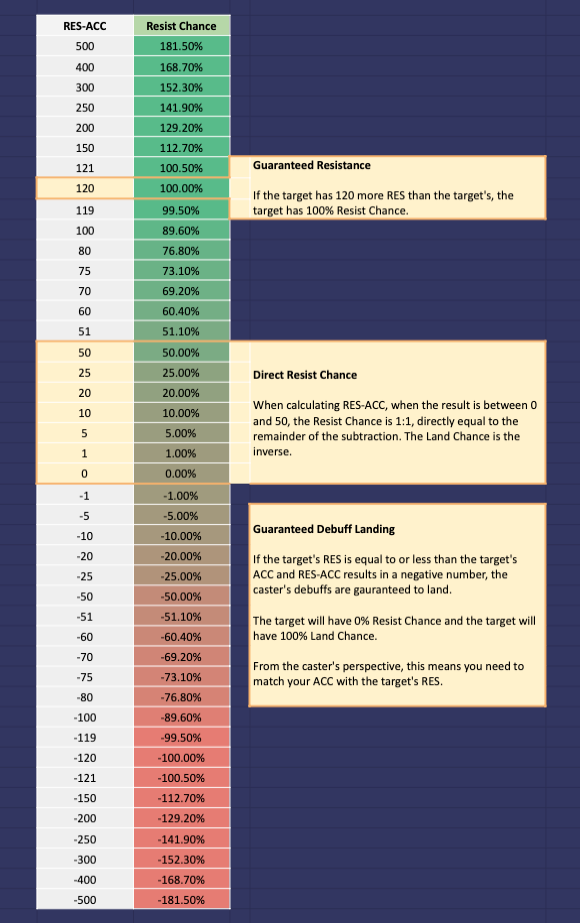
As mentioned, this covers Phase 1 of the Resistance Check – calculating our Initial Resist Chance.
If no other Resist Chance Modifiers exist, then anything above 100% Resist Chance or below 0% Resist Chance is surplus – and that's all you need to figure out your chances of landing or resisting any debuffs.
However, in most scenarios, Resist Chance Modifiers will need to be factored in.
This process is quite simple, but potentially unintuitive.
We take your Initial Resist Chance (IRC) as a percentage
We add or subtract all Resist Chance Modifiers directly as percentages
The result is your Final Resist Chance
Let's dive into what Resist Chance Modifiers are:
RESIST CHANCE MODIFIERS
Resist Chance Modifiers are added to or subtracted from your Initial Resist Chance (IRC) directly as percentages.
Important: Remember that we only process and calculate one side of the equation – the Resist Chance. Therefore, ACC Up buffs don't get added to any “Accuracy” side of the equation – they are subtracted from the Resist Chance.
Therefore, we can group them as follows:
Effects that are added to your Initial Resist Chance:
Resist Chance Up Effects |
+ ACC Down |
+ RES Up |
+ Mindfog Corruption |
+ Target Element Advantage |
Each of these effects are directly added to your Initial Resist Chance.
Example:
If you have a 20% Initial Resist Chance and a 50% ACC Down debuff, this is added directly to your IRC (20% + 50%) to calculate your Final Resist Chance (FRC). Your Final Resist Chance in this case would be 70%. And therefore, 30% chance of a successful debuff.
Effects that are subtracted from your Initial Resist Chance:
Resist Chance Down Effects |
- ACC Up |
- RES Down |
- Target Element Disadvantage |
- Atrophy Corruption |
Example:
If you have a 40% Initial Resist Chance and a 30% RES Down debuff, this is subtracted directly from your IRC (40% - 30%) to calculate your Final Resist Chance (FRC). Your Final Resist Chance in this case would be 10%. And therefore, 90% chance of a successful debuff.
IMPORTANT
RES Up, RES Down, ACC Up, and ACC Down, do not directly change the target's Accuracy or Resistance Stats in-battle.
They only come into play at this second stage of the Resistance Check.
Therefore, if you have a Skill that carries out a certain action if their RES is higher or lower than their ACC, or higher or lower than the target's ACC, then these will be unaffected by any ACC or RES buffs and debuffs.
Let's go through a full example calculating our Final Resistance Chance.
Phase 1: Calculating IRC.
Ulgorim's RES: 380
Brandis’ ACC: 260
RES-ACC = 120
Initial Resist Chance = 100%
Phase 2: Applying Resist Chance Modifiers
Ulgorim is Elemental Advantage (Water) vs Brandis (Fire).
+ Target Elemental Advantage (+50%)
- Target Elemental Disadvantage (-0%)
= 150% Resist Chance
Ulgorim has a RES Down debuff, but no RES Up debuff.
+ RES UP (+0%)
- RES Down (-70%)
= 80% Resist Chance
Brandis has an ACC Up buff, but no ACC Down buff.
+ ACC Down (+0%)
- ACC UP (-50%)
= 30% Resist Chance
Ulgorim doesn't cast Mindfog or Atrophy Corruption, so there are no Corruptions to factor in.
+ Mindfog Corruption Stacks on Caster (0%)
= 30% Resist Chance
After factoring in every Resist Chance Modifier, we have our result:
Final Resist Chance
Final Resist Chance = 30%.
Note: Remember that after the calculation is complete, the Final Resist Chance will be normalized to between 0% and 100% – even if the numbers go above or below that at any point during the calculation.
ELEMENTS & ENEMY TARGETING
In the Arena, your opponents’ Arena Defenses are controlled by the AI.
And just like in other game modes, enemy targeting in the Arena is primarily defined by your Tactic and the formation of your tactic.
Enemies will target your Front Line Invokers before they target the rest of your team – ignoring Elements and other factors.
It works the same as in other game modes, with enemies targeting your team with a slot-style filtering system.
Front Line Invoker have 2 Enemy Slots each
Mid and Back Line Invokers have 1 Slot each
Each Front Line Invoker has 2 Enemy Slots that should be filled before the enemies consider them occupied and move onto targeting the next unoccupied enemy.
Note: In PvE this works by enemy groups, and with larger groups of enemies, they begin to cycle back around for target selection. Once your whole team has been occupied by enemy targets, they'll cycle back around and remaining enemies will target your Front Line first. Front Line Invokers should roughly always have a 2:1 ratio of enemies targeting them compared to Invokers in other lines – but they may have more.
It's not the easiest to explain, but think of it like a dealer deals cards to people around a table – in this case, the Enemy Dealer – where Front Line Invokers must take 2 before the enemies begin to target your other team members.
In the Arena, it works as follows:
Against Tactics with 1 Front Line Invoker
Enemy 1 ➤ Front Line Invoker 1
Enemy 2 ➤ Front Line Invoker 1
Enemy 3 ➤ Mid or Back Line Invoker
Enemy 4 ➤ Mid or Back Line Invoker
Whether the remaining enemies target Mid or Back Line Invokers depends on other factors such as tactic, positioning, whether they're being actively attacked, and so on.
Against Tactics with 2 Front Line Invokers
Enemy 1 ➤ Front Line Invoker 1
Enemy 2 ➤ Front Line Invoker 1
Enemy 3 ➤ Front Line Invoker 2
Enemy 4 ➤ Front Line Invoker 2
This means when the battle begins, the enemy team will immediately rush to fight those Invokers.
As you can tell, running a formation with 2 Front Line Invokers opens up to a huge avenue for you to exploit.
Since this targeting system totally ignores Elements, you can run a formation with 2 Front Line Invokers of a stronger Element than your opponent, and the enemy team will attack them blindly.
This can give you a huge advantage and massively weakens their Arena Defense. It will result in the Arena Defense having:
-30% Damage output
-50% Crit Rate
+50% Resist Chance for your Front Line Invokers
These penalties are massive. Someone with a 100% Crit Rate Invoker only now has a 50% chance of a crit, which means they've wasted stats investing in Crit Damage. Combined with 30% less damage in the first place, and they might as well be hitting you with pool noodles.
And that Resist Chance is nothing to be sniffed at. In the Arena, you're likely to have similar ACC and RES numbers to your opposition: +50% Resist Chance can shut down the other team's debuffs entirely.
Combined with your Front Line's advantages vs the opposition:
+30% Damage output
-20% Resist Chance for the enemy
… and you can see why understanding this system can have benefits for your team.
Important: Remember that in the Arena, Light and Dark Elements will always be at Elemental Advantage over one another, simultaneously. This means that Light vs Dark, opposing each other, will both have +30% Damage and the Resist Chance modifier.
ELEMENTS & DEFENSE
The flipside of the coin above is that this also works against you.
Your Arena Defense setup can be easily exploited unless you either have a mix of four Elements, or only use Light and Dark Invokers.
If not, prepare for attackers to simply use strong Elements against you – the fact that your Defense will ignore their Element means another player can beat your Defense, even with far lower Stats and power.
TITAN ORDER
Setting the right Titan Order, in both Offense and Defense, can give you a huge edge on your competition.
Factor in everything you know so far, and understand which Invokers are likely to be in the right position, at the right time, to invoke a devastating Titan assault.
This is only the beginning of Arena strategy – we're excited to see what you all discover.
See you in the Arena.